
Corporate Earnings Resilience Amidst Global Macro Divergence - Insights from US and European Markets
Amidst global economic divergence, why are corporate earnings defying macro headwinds, and what does this tell us about where resilient investment opportunities truly lie in a rapidly evolving world


In an increasingly complex and divergent global economic landscape, investors are facing unprecedented challenges and opportunities. Two recent reports from Goldman Sachs delve into key trends in the current US and European markets, revealing corporate earnings resilience amidst macroeconomic headwinds, and highlighting potential changes and opportunities for investors within the evolving policy and geopolitical landscape.
US Market: Divergence Between Strong Micro Earnings and Macroeconomic Slowdown
The recent US corporate earnings season has presented a remarkable picture: despite a slowdown in overall macroeconomic activity, S&P 500 companies have shown exceptionally strong earnings performance, drawing market attention to the significant divergence between the two.
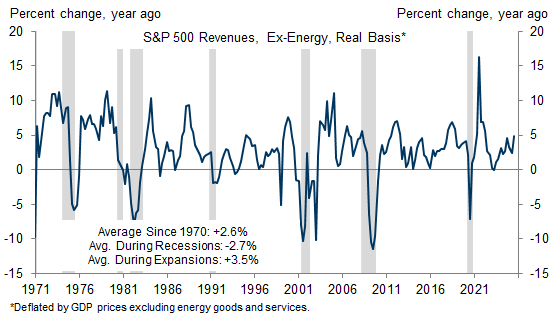
During the Q2 2025 earnings season, S&P 500 companies' earnings growth reached 11%, significantly exceeding the initial expectation of just 4% at the beginning of the quarter. Approximately 60% of S&P 500 companies beat analyst consensus estimates, higher than the long-term average of 48%. Furthermore, 58% of companies raised their full-year earnings guidance, notably above the historical average of 46%. Excluding the energy sector, the S&P 500's real revenue year-over-year growth increased to 4.8%, up from 3.3% in Q4 2024, and also surpassed the average of 3.5% during expansionary periods over the past 50 years, signaling an acceleration in corporate revenue growth to its highest level since early 2022.
Source: Goldman Sachs
However, this strong micro-level performance contrasts sharply with macroeconomic data: US GDP year-over-year growth decelerated from 2.5% in Q4 2024 to 2.0% in Q2 2025, with an annualized growth rate of only 1.2% for the first half of 2025.
Two main reasons account for this divergence:
- International Business Exposure and Dollar Depreciation: S&P 500 companies have greater international sales exposure and have benefited from the recent depreciation of the US dollar. On a constant exchange rate basis, S&P 500's real sales growth decelerated to 2.7%. Notably, small and mid-cap companies experienced negative real sales growth on a constant exchange rate basis, further highlighting the supportive role of international business and exchange rates for large corporations' earnings.
- Information Technology Company Weighting: Fast-growing Information Technology companies (median sales growth 11%) hold a significant weighting in the S&P 500, and their strong performance has significantly boosted the overall index's earnings level.
Consumer Sentiment and H2 Outlook Although consumer health showed some quarter-over-quarter improvement in Q2, it remained weak. Quantitative indicators of consumer sentiment from earnings calls partially rebounded after declining in the previous quarter. However, the outlook for the second half of 2025 remains challenging, with real consumer spending growth projected to be only 1% annualized. This is primarily due to slower real income growth, influenced by weaker labor growth, rising inflation caused by tariffs, and reduced transfer payments from the Q4 2025 fiscal bill. Real income growth for 2025 is expected to be 1.5% (Q4/Q4), down from 2.3% in 2024, and performance for low-income and high-income quintiles may be suboptimal.
Regarding the labor market, companies generally confirmed weaker employment growth, indicating that the labor market has fully rebalanced. Concerns about labor costs have fallen to the low end of the pre-pandemic range, suggesting the labor market is no longer tight.
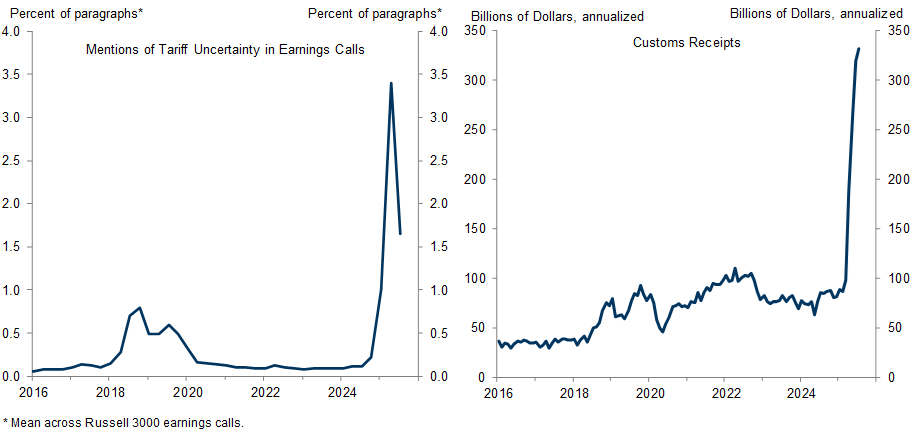
Tariff Impact: From Uncertainty to Real Costs The impact of tariffs on businesses has shifted from early discussions of uncertainty to actual costs. Management's frequency of mentioning tariff uncertainty has significantly decreased, but tariff payments have substantially increased, reaching an annualized $320bn by June.
Source: Goldman Sachs
Many companies reported tariff pressure on profit margins; for instance, Ford had a net tariff impact of approximately $800mn in Q2, GM about $1.1bn, and Apple incurred about $800mn in tariff-related costs in the June quarter. To mitigate tariff impacts, companies generally adopted various strategies:
- Approximately three-quarters of companies are negotiating with suppliers or adjusting supply chains.
- Slightly more than half of companies are passing costs on to customers.
- Slightly less than half of companies are seeking cost savings elsewhere.
Discussions about tariff-induced price increases persist, with companies having higher tariff cost exposure announcing higher price hikes. Additionally, some companies plan to reduce costs by cutting hiring, laying off staff, or investing in AI solutions to counter the labor market effects of tariffs.
OBBBA's Boost to Business Investment The OBBBA, signed into law on July 4, includes several business investment tax incentives aimed at boosting capital expenditures (capex). However, the Act's passage had limited impact on Q2 analyst expectations and company guidance, likely because the market widely anticipated its approval, and its positive effects were priced in beforehand.
European Market: Resilience, Selective Opportunities, and Shifting Macro Forces
Similar to the US market, European equities stabilized after a strong start in 2025. Despite pressure from downward revisions to earnings expectations, Goldman Sachs believes the European market remains attractive and emphasizes the importance of a selective investment strategy.
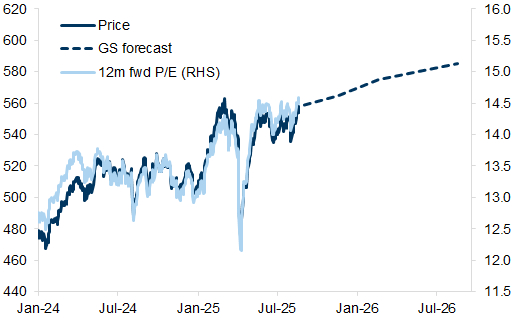
European Equity Performance and Earnings Outlook European equities performed strongly in early 2025, but the STOXX Europe index has traded sideways since March due to tariff news and disappointing earnings performance. Current market consensus expects 2025 EPS growth to be -1%, significantly lower than the 8% forecast in January, primarily attributed to the depreciation of the US dollar.
Goldman Sachs forecasts STOXX Europe index EPS growth of 0% in 2025 and 4% in 2026, reflecting improving European GDP growth. However, a persistently strong Euro (with EUR/USD projected to rise to 1.25 over the next 12 months) will significantly weigh on overseas earnings; every 10% appreciation in EUR/USD will reduce European EPS by 2-3 percentage points. Therefore, selective investment is crucial.
Source: Goldman Sachs
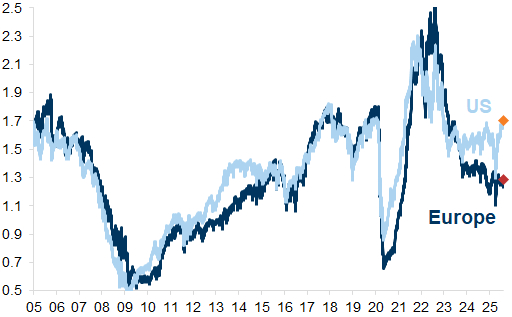
Valuation Analysis: High in Absolute Terms but Relatively Reasonable The STOXX Europe index's forward P/E is 14.4x, placing it at the 70th percentile of its historical valuation range since 2000. However, Goldman Sachs considers its valuation relatively reasonable, as it is not excessively priced compared to sovereign spreads or Euro high-yield bond spreads. More importantly, European equities still trade at a deep discount relative to US equities, even after adjusting for sector exposure or differing growth expectations.
Source: Goldman Sachs
Investor Positioning and Earnings Resilience After years of continuous outflows, investor long-term allocation to European equities remains light, but inflows increased in 2025, consistent with investors' demand for portfolio diversification.
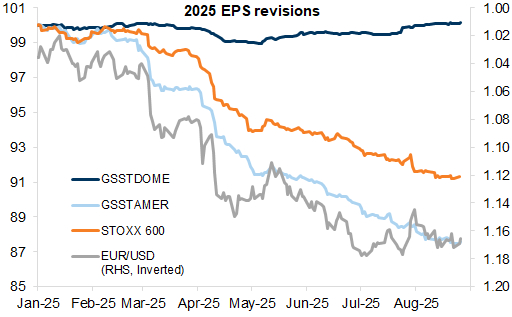
In terms of earnings performance, the Q2 2025 earnings season met expectations, but earnings forecasts for 2025 and 2026 were revised down across almost all sectors, mainly due to foreign exchange factors. However, domestic stocks (GSSTDOME) maintained earnings resilience, and this divergence is expected to persist.
Source: Goldman Sachs
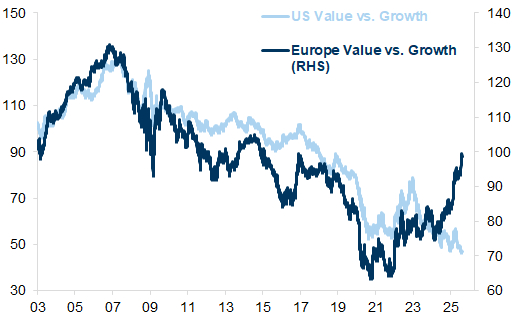
Style Divergence and Shifting Macro Forces US and European markets exhibit distinct investment styles: Value stocks (such as Banks, Insurance, Utilities, Telecoms) performed well in the European market, while the US market was dominated by Growth stocks (Tech/AI).
This style divergence is underpinned by a reversal of macro forces: the US dollar is falling, US economic growth is slowing; trade barriers are rising; and the relationship between China and Europe is changing from a high-growth market to a major competitor exporting deflation. These shifts in macro forces are seen as medium-to-long-term trends, thus the European market is not expected to quickly revert to "growth" or "quality" stocks.
Source: Goldman Sachs
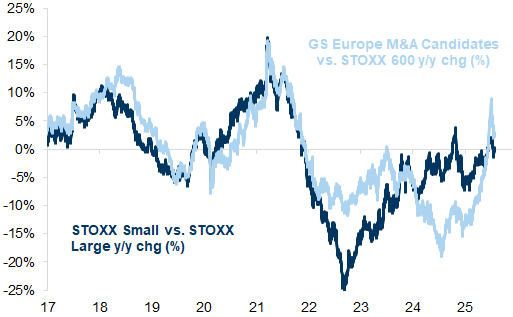
Increased M&A Activity Benefits Small and Mid-Cap Stocks European small and mid-cap stocks have performed exceptionally well this year, partly benefiting from Goldman Sachs's above-consensus forecast for European economic growth, as well as a persistently strong M&A backdrop. The proportion of corporate cash used for M&A is projected to increase by 10% in 2026, providing additional support for small and mid-cap stocks.
Source: Goldman Sachs
Conclusion and Investment Implications
Overall, the current global economy and markets are in a critical transition period, exhibiting significant divergence. The resilience of US corporate earnings primarily stems from their international business exposure, dollar depreciation, and the strength of the Information Technology sector, while macroeconomic challenges (such as slowing consumer spending and tariff costs) should not be overlooked. Although the European market experienced a stable period after a strong start and saw downward revisions to earnings expectations due to foreign exchange factors, its relatively reasonable valuation, light investor positioning, and expectations of domestic economic improvement may still offer selective investment opportunities.


