
What Does the Bear Say about AI Investment? Mind the Gap Between Macro Math and Micro Mania
Bear says that AI valuations are currently pricing in a "perfection" scenario that exceeds theoretical economic limits by trillions, yet Hyperscalers' capital expenditure engines showing no signs of cooling down


AI at a Crossroads: Where Macro Arithmetic Meets Micro-Mania
As we survey the investment landscape near the close of 2025, a palpable tension emerges. At the macro level, the market appears to have overdrafted its imagination for the future, with valuations not just front-running but, in some respects, defying fundamental arithmetic. Yet, at the micro level, Silicon Valley's giants show no signs of slowing their spending spree; the capital expenditure frenzy rages on.
This divergence forms the core narrative of the current market. According to the latest research from Goldman Sachs and Citi Research, we are standing at a delicate crossroads: smart money is attempting to exit the crowded "selling shovels" trade, searching for the next, underpriced frontier.
A Cold Dose of Macro Reality: The Nineteen-Trillion-Dollar Gamble
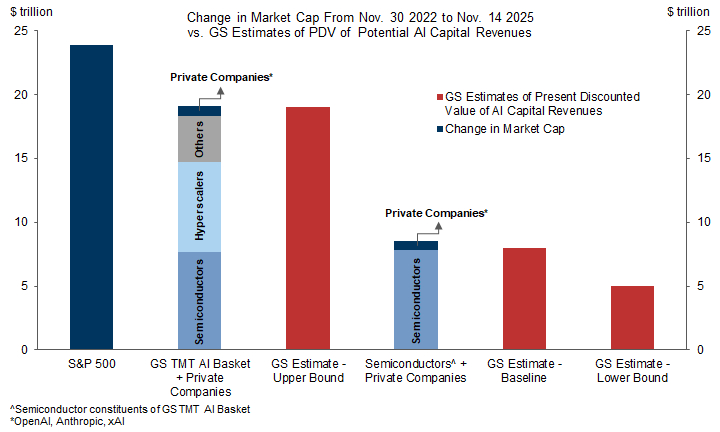
Let's first confront a disquieting number. Since the debut of ChatGPT, the total market capitalization of AI-related companies has surged by approximately $19tn. This is an astronomical figure, enough to make any rational observer dizzy. The growth has been driven primarily by Semiconductors and the model builders, with these two sectors alone contributing over $8tn of the increase.
However, a macro model from Goldman Sachs pours cold water on these scorching expectations. Their analysis indicates that even in an optimistic scenario, the baseline Present Discounted Value (PDV) of potential capital revenues from AI is a mere $8tn. Under the most aggressive assumptions, this figure only reaches $19tn.
What does this imply? It suggests the market has already priced in perfection: a scenario where every ounce of productivity gain flawlessly converts into corporate profit, miraculously un-eroded by the fierce winds of competition.
Market Pricing vs. Theoretical Gains: The Double-Counting Trap
Two cognitive traps are propping up these high valuations. The first is the "Fallacy of Aggregation." Investors seem to mistakenly believe that every link in the supply chain—from chipmakers to cloud providers to model developers—can simultaneously claim the largest slice of the pie. But economic common sense dictates that their combined value capture cannot exceed the total incremental earnings generated by AI across the entire economy.
The second is the "Fallacy of Extrapolation." The market tends to treat the short-term excess profits born from technological monopolies as a permanent state of affairs. Yet, history has repeatedly shown that long-term competition inevitably compresses returns. The vast gap between the current market cap growth and the theoretical baseline, as shown in the chart below, points to a severe risk of "double-counting."
Change in Market Cap vs. GS Estimates of PDV of Potential AI Capital Revenues
Source: Goldman Sachs Global Investment Research
The Capex Frenzy: An Arms Race Among Giants
While macro valuations appear precarious, the engines of this AI rally—the Hyperscalers (including Amazon, Google, Meta, Microsoft, and Oracle)—are far from finished with their arms race. This micro-level investment fervor is the other pillar supporting market confidence.
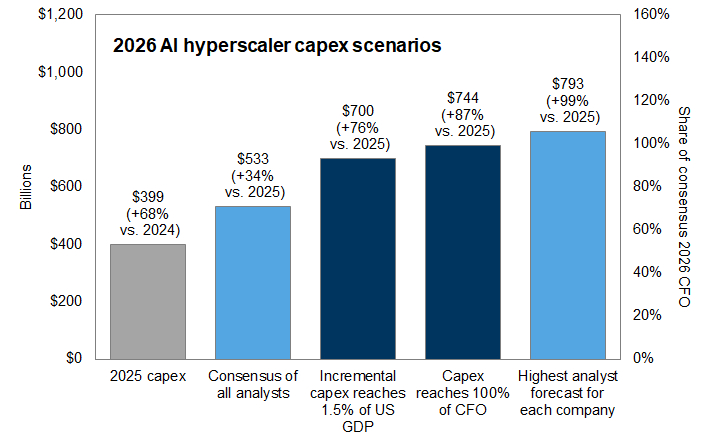
Analysts, it seems, have consistently underestimated the intensity of this tech cycle. The consensus capital expenditure (Capex) estimate for 2026 has already been revised upward to $533bn, a staggering 34% year-over-year increase. If we look back to the telecom boom of the 1990s, investment intensity once reached 100% of operating cash flow. If history serves as a guide, 2026 Capex could potentially hit a stunning $700bn, which is $200bn higher than the current consensus.
Behind this seemingly frenetic spending lie the exceptionally strong balance sheets of these giants. Even if Amazon or Google were to increase their leverage, they have ample room to take on more debt without damaging their valuations. The real bottleneck may not be corporate ability to pay, but the credit market's capacity to absorb it—the scale of new debt could squeeze market liquidity.
2026 AI Hyperscaler Capex Scenarios
Source: Goldman Sachs Global Investment Research
The Next Alpha: From "Selling Shovels" to "Using Them"
Given that the margin for error in infrastructure valuations is now razor-thin, the investment thesis must evolve. Current stock market returns are highly concentrated in infrastructure (Phase 2), with these stocks delivering a 35% return this year and share prices significantly outpacing earnings per share (EPS) growth.
Smart money is beginning to shift its focus toward Phase 3 (AI Platform) and Phase 4 (AI Productivity). This is a realm that has not yet been fully priced. As enterprise adoption rates climb—with 62% of S&P 500 companies mentioning AI in their Q3 earnings calls—the rollout of applications is accelerating.
AI Platforms (Phase 3) occupy the middle layer between infrastructure and end-user applications. Companies like Snowflake and MongoDB, despite divergent performance year-to-date, have valuations that appear more reasonable relative to their EPS growth. Laggards in this space, such as Elastic NV, present a clear logic for a catch-up rally.
More compelling is AI Productivity (Phase 4). The screening logic here is straightforward: identify companies with high labor intensity and significant exposure to AI-driven automation. The financial services, software services, and professional services sectors are the primary beneficiaries of this theme. Although this basket has underperformed the broader market since late 2023, its EPS revisions have been remarkably strong. This suggests that share prices have yet to reflect the fundamental improvements—precisely the margin of safety value investors seek.
Risk Radar: Cracks in the Credit Market
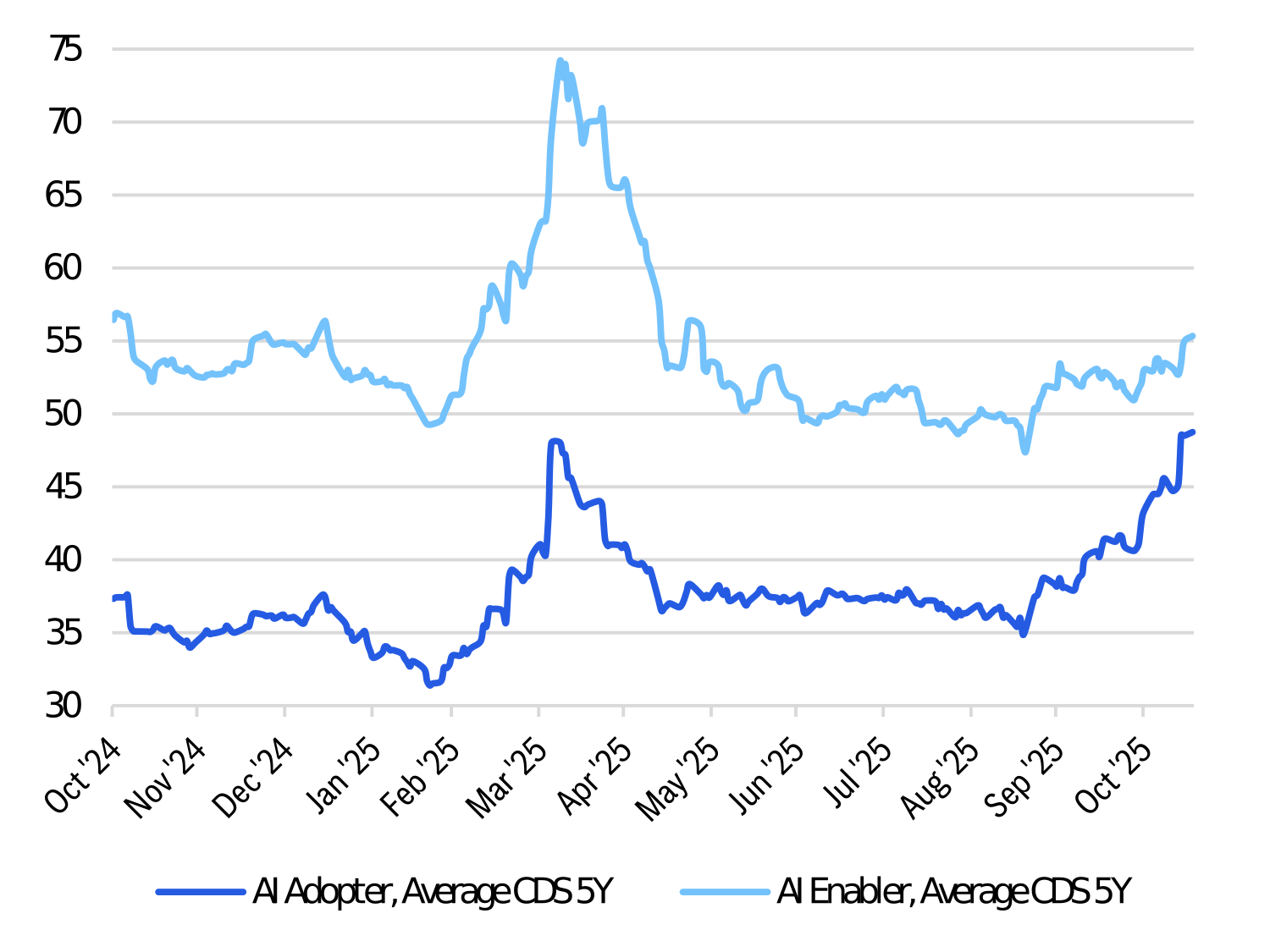
While we bask in the glow of the stock market's prosperity narrative, the credit market often sniffs out danger more acutely. A report from Citi Research notes that while the market is currently in a "boom" rather than a "bubble," Credit Default Swaps (CDS) have begun flashing warning signals.
A critical divergence is underway: the credit risk for AI Adopters is rising significantly faster than for AI Enablers (hardware providers). This indicates that the market is growing concerned about the monetization capabilities of downstream applications. After all, buying expensive GPUs is the easy part; turning that compute power into real cash flow is the challenge.
Furthermore, "shadow leverage" is a hidden risk that cannot be ignored. Issuance of Data Center Asset-Backed Securities (ABS) is growing at 60% annually, and a vast number of AI startups rely on equity investments from tech giants for funding. This nested financial relationship leads to a potential inflation of profits—for example, a significant portion of Google's profit comes from "other income," which includes unrealized gains on investments. Once the valuation bubble in the startup world corrects, this feedback loop could quickly boomerang onto the giants' financial statements.
5-Year Average Performance of AI CDS: Adopters vs. Enablers
Source: Citi Research
Conclusion
At this crossroads for AI investing, blindly chasing infrastructure plays may no longer be the optimal strategy. The gravity of macro arithmetic will eventually take hold, pulling valuations that have escaped Earth's pull back to the ground. However, this does not signal the end of the rally, but rather a rotation in investment themes.
As Hyperscalers continue to lay the digital railroad tracks for the world, the real opportunity is quietly shifting to the platform and application companies that can leverage this infrastructure to boost efficiency and reshape business models. For investors, the task now is not to predict when the bubble will burst, but to identify who can truly deliver on the promise of this productivity revolution.
I will share a more detailed version of this post with more charts to my subscriber only:


