
Soaring Productivity and Labor "Anemia" - The Implications of AI-Driven US "Jobless Growth"
How will the twin forces of AI-driven productivity and restrictive immigration policies reshape the US "jobless growth" landscape, and what does this mean for US equity demand in 2026?


Soaring Productivity and Labor "Anemia": The Asset Allocation Implications of AI-Driven US "Jobless Growth"
The global macroeconomic landscape sees the United States economy perched precariously on a pivotal crossroad. On one hand, the Artificial Intelligence (AI) revolution promises a dramatic surge in productivity, injecting optimism into long-term Gross Domestic Product (GDP) growth projections. On the other, labor supply is struggling, hampered by demographic aging and increasingly restrictive immigration policies. This "high-growth, low-employment" dynamic, often termed "Jobless Growth," is emerging as the central narrative for institutional investors like Goldman Sachs.
We integrate recent macro analyses to address a critical question: How will the dual forces of AI-driven productivity and constrained immigration policies redefine the US "jobless growth" environment, and what does this portend for US equity demand in 2026?
Act I: The Productivity Surge and Supply-Side Constraints
Goldman Sachs Global Investment Research analysts Pierfrancesco Mei and David Mericle contend that the vast majority of future US potential GDP growth will not stem from the expansion of the labor force size, but rather from robust productivity gains, a structural dividend delivered by advancements in AI.
Crucially, the contribution from labor supply growth is expected to be quite modest, primarily due to an aging population and a reduction in net immigration. This fundamental shift reorients the US economy's growth foundation from labor-intensive toward efficiency-intensive models.
Structural Shift in Potential GDP Growth
As illustrated in the chart below, labor productivity growth (dark blue section) is projected to bear almost the entire burden of potential GDP growth between 2025 Q3 and 2029, while the contribution from labor supply growth is significantly below historical levels.
Contributors to Annual US Potential GDP Growth
*Source: Goldman Sachs
Subtle Signals in the Job Market and Corporate Intent
If AI is indeed driving sweeping efficiency gains, the central query becomes whether labor demand growth can keep pace with even the modest increase in labor supply. Recent labor market data reveals concerning signals:
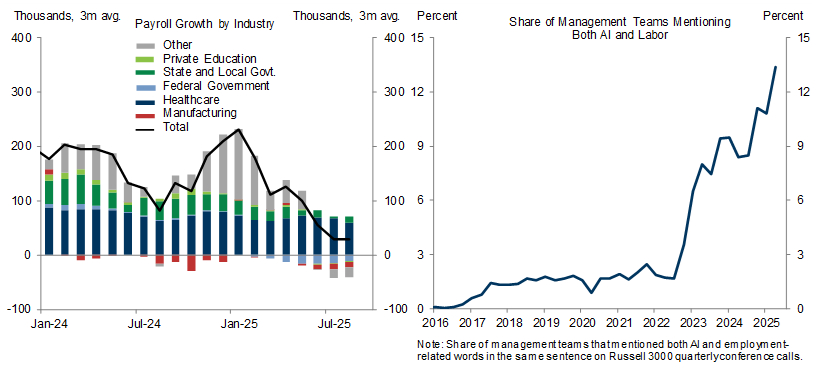
- Non-Healthcare Sector Weakness: Net employment growth outside the Healthcare industry has actually turned negative in recent months. This suggests that the broader economy may be actively internalizing the impact of efficiency improvements.
- Management Focus on AI-Driven Cost Reduction: Corporate management teams are increasingly focused on leveraging AI to reduce labor costs, as evidenced by earnings call transcripts. This indicates that the corporate intention to "substitute human labor with machines" is translating into practical business strategy, posing a long-term structural headwind to labor demand.
Corporate Focus on AI Cost Reduction and Non-Healthcare Employment
Source: Goldman Sachs
Act II: Immigration Constraints Exacerbate Supply-Side Pressure
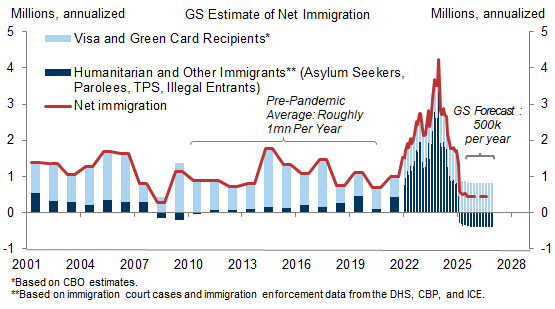
Against a backdrop of already limited labor supply, the tightening immigration policies enacted by the Trump Administration further compound the structural challenges. A report by Goldman Sachs analyst Elsie Peng indicates that these policy shifts are causing a noticeable decline in authorized net immigration inflows to the United States.
Goldman Sachs anticipates that total net immigration for the full year 2025 will decrease to approximately 0.5 million people, significantly lower than the pre-pandemic average of 1.0 million annually.
Loss of Authorized Immigrants and Challenges in Talent Acquisition
The new policies impact the system in several ways:
- H-1B Visa Barriers: The new $100k H-1B application fee, while having a limited effect on for-profit applicants subject to the 85k cap, poses a greater challenge to "Cap-Exempt" institutions such as universities and non-profit research organizations. In these institutions, approximately 75% of H-1B applicants are projected to have annual salaries below $100k. The high fee may force these organizations to forgo bringing in crucial research talent, thereby subtly undermining the long-term vitality of the American innovation ecosystem.
Shift in Enforcement Focus: With a sharp drop in illegal border crossings, Immigration and Customs Enforcement (ICE), responsible for interior enforcement, has dramatically increased arrests within the United States. This intensified enforcement regime may lead to a drop in the willingness of new immigrants to respond to government surveys, and potentially even reduce their propensity to seek employment, adding uncertainty to labor market statistics and forecasts.
US Net Immigration Estimates and Forecast
Source: Goldman Sachs
Act III: The Double-Edged Sword of Technological Advancement – Substitution or Augmentation?
The pivotal risk in the "Jobless Growth" scenario hinges on whether the technology primarily acts as a "Labor-Substituting" or "Labor-Augmenting" force. Historical data offers a critical warning:
- Essential Difference in Technology Types: Since 1980, occupations heavily affected by labor-augmenting technologies have experienced employment growth rates far exceeding the average. Conversely, employment growth in occupations impacted by labor-substituting technologies has been consistently slow, with negative effects intensifying since the 1990s. If AI predominantly proves to be a substituting technology, the challenge of maintaining full employment will be severe.
Impact of Technology Type on Employment Growth
Source: Goldman Sachs
Recession: The Amplifier for Technological Displacement
Historical experience further indicates that the full negative impact of technology on employment often only manifests during economic recessions.
- Since the 1970s, approximately half of the job losses in Routine Manual Occupations occurred during periods of recession. Companies typically use economic downturns as opportunities to restructure and streamline operations, shedding employees in less productive areas.
- A notable example is the "Jobless Recovery" following the 2001 recession: productivity growth remained high while the labor market languished, taking over two years for total employment to return to pre-recession levels.
- Today, Routine Cognitive Jobs are most susceptible to the threat of AI. This suggests that should the next economic downturn occur, it may trigger a "Jobless Recovery" targeting middle-to-high-skilled white-collar positions, thereby exacerbating polarization in the labor market.
Act IV: Capital Flows and Market Outlook for 2026
In a macro environment characterized by AI-driven productivity dividends, moderate inflation, and a soft labor market, the Federal Reserve (Fed) and the European Central Bank (ECB) would typically maintain lower policy interest rates to support the labor market. This combination of "high growth + low interest rates" inherently provides a strong foundation for asset prices, contingent upon the labor market weakness not deteriorating to the point of triggering a full recession.
So, specifically for the 2026 US equity market, where will the capital flows originate?
Household Flows: The Largest Source of Demand
Goldman Sachs forecasts that net US equity demand in 2026 will be primarily driven by three groups: Households, Corporates, and Foreign Investors. Households are projected to be the largest contributor, with net purchases expected to reach $520 billion, marking a 19% year-over-year increase.
Household demand is driven by the improving macro backdrop—accelerated economic growth, falling unemployment, and the expected Fed rate cutting cycle. Despite falling cash yields, GS believes that household equity demand will be funded primarily by income rather than a massive asset rotation from the $11 trillion money market funds.
It is crucial to note the high concentration of household wealth: the wealthiest 1% of households own $26 trillion in stocks and mutual funds, accounting for 50% of total household equity holdings.
Household Equity Ownership Breakdown
Speculative Frenzy: Localized Bubbles Continue to Inflate
While the broad investor positioning (the US Equity Sentiment Indicator registered +0.3) remains in the neutral zone, localized speculative trading activity has intensified. Sectors associated with quantum computing, cryptocurrencies, and drones have all seen significant gains in the past 1 month.
The Speculative Trading Indicator remains elevated, accompanied by a sharp short squeeze: a basket of the most concentrated short positions yielded a staggering 24% return in the past 1 month, placing it in the 99th percentile of historical monthly returns. This speculative behavior correlates most strongly with the equity demand of households ranked between the 50th and 90th wealth percentiles.
Corporates and Foreign Investors: Reliable Support
- Corporates: Forecasted net demand of $410 billion in 2026. Robust earnings growth and expectations of rate cuts are expected to sustain stock buybacks. Year-to-date, authorized buybacks have hit a record $1.1 trillion, a 16% increase over the previous year, providing a strong structural bid to the market.
- Foreign Investors: Projected net purchases of $250 billion. Although the forecast represents a -56% year-over-year decrease, foreign investors remain a significant source of demand. Historically, foreign demand is strongest when the US Dollar is weak and US equity performance lags global indices.
Conclusion: Balancing Optimism with Prudence
The US economy stands at the vanguard of AI-driven productivity, a clear foundation for long-term optimism. However, this growth model is not without cost. Labor supply is doubly constrained by immigration policy and demographics, while the risk of AI-driven job substitution may be amplified during the next recession, leading to a macro environment of falling inflation and lower interest rates.
This unique combination of efficiency and labor market weakness provides robust capital flow support for the 2026 US equity market. As long as macro policy successfully contains the labor market softness within a "moderate" range—preventing it from escalating into a full-blown recession—the capital demand driven by Households, Corporates, and Foreign Investors will continue to act as a significant tailwind for US stocks.
While enjoying the productivity dividends of AI, investors must remain alert to its structural impact on the labor market and maintain a critically prudent stance amid the current environment of heightened speculative fervor.


